
Hebei Facts
 As an important province in North China, Hebei ( means north of the (Yellow) River), completely surrounds Beijing and Tianjin municipalities, and borders Liaoning province to the northeast, Inner Mongolia autonomous region to the north, Shanxi province to the west, Henan province to the south, and Shandong province to the southeast.
As a part of the North China plain, Hebei province lives more than 70 millions in 187,693 square KM, and the provincial capital is Shijiazhuang. In ancient China, Hebei known as Yanzhao, for the state Yan and the state Zhao existed here during the warring states period.
The most parts of the central and southern lies in the North China Plain. Meanwhile, the western part of Hebei rises into the Taihang Mountains and the the Yan Mountains (Yan Shan) run through northern Hebei. The grasslands of Inner Mongolia just lie beyond the Yan Mountains.
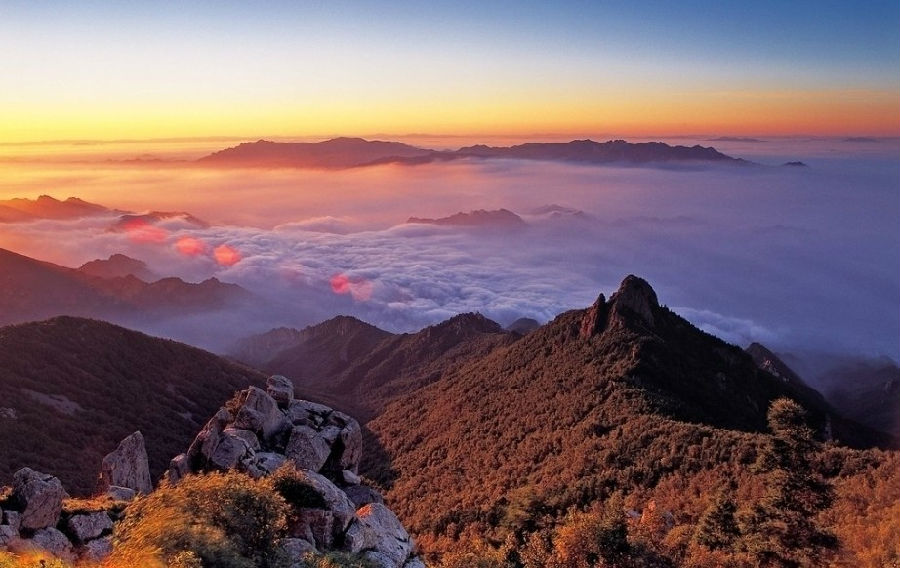
The Great Wall cuts through northern Hebei from east to west and then enter the border Beijing and at lat terminates at the seacoast og Shanhaiguan Pass in Northeastern Hebei. The Mount Xiaowutai, located in northwestern Hebei, is the highest peak with an altitude of 2882 meters.
Bohai Sea borders Hebei on the east. Hai He River watershed covers most of the province’s central and southern parts. Luanhe River watershed covers the northeast. Hebei is really rich in natural reservoirs among hills and mountains. The largest lake is the Baiyangdian白洋淀, located mostly in Anxin County.
